Services · 02
Pondless Waterfalls & Streams
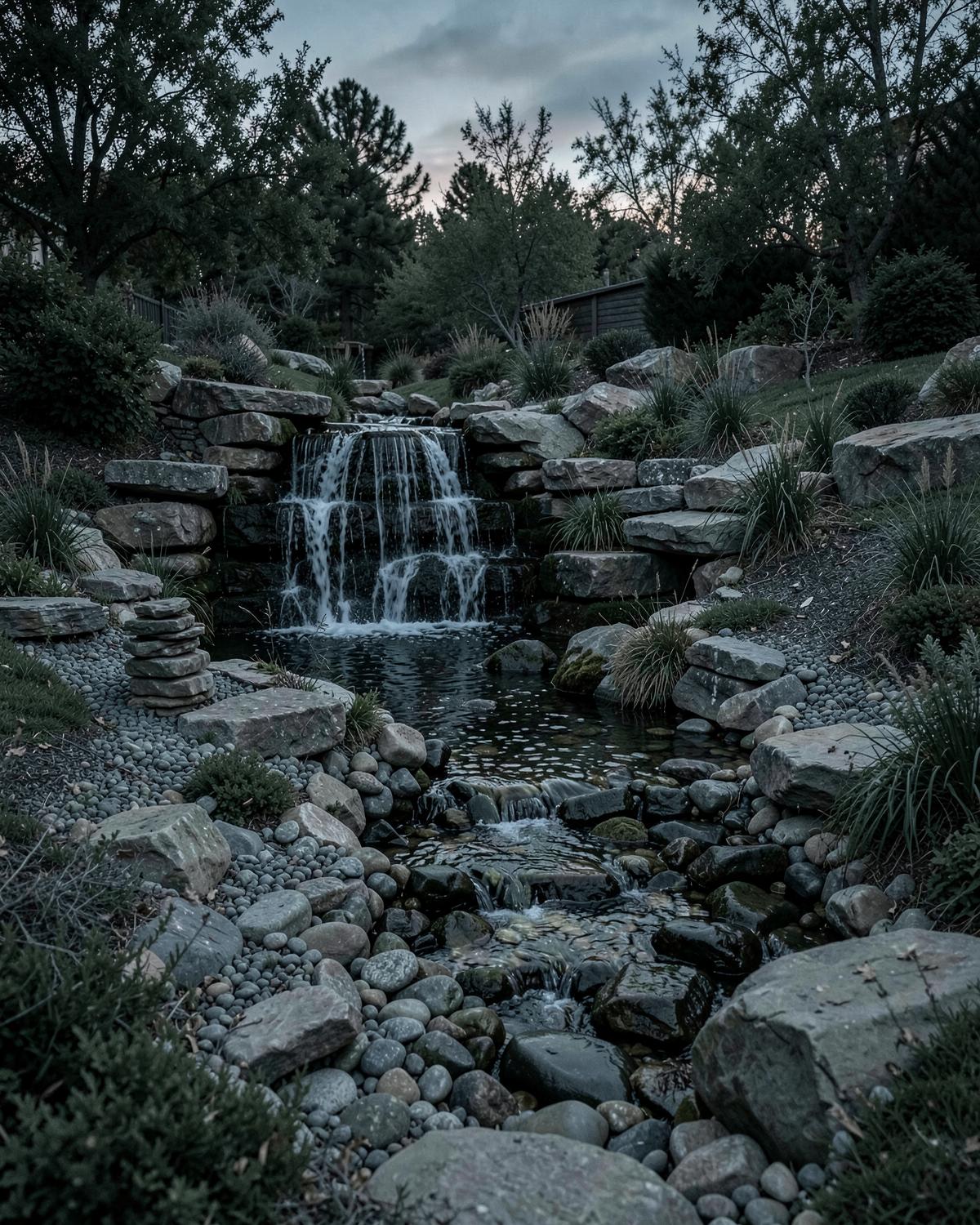
A pondless waterfall gives you the sound of a creek without standing water — the right answer for families with small children, owners who travel, tight courtyards, or a slope that already needs to shed runoff. The reservoir sits buried under gravel; the streambed above it is graded, shimmed and rock-set until the water breaks exactly the way you want it to.
What the build includes
- Buried reservoir vault sized to the run, with service access for the pump
- Graded streambed with dry-set falls and individually tuned weir stones
- Recirculating plumbing with auto-fill and clean-out access
- Stone selection matched to the house and existing hardscape
- Grade and drainage correction integrated into the run
- Submerged and grazing lighting on the falls
- Debris management detailing so leaves do not end up in the reservoir
At a glance
- Typical run
- 8–45 ft
- Typical fall
- 1–6 ft
- Typical build window
- 1–3 weeks
- Typical investment
- $15,000–$45,000
Every project is different. Access, ground conditions, working depth, stone selection and scope all move both the price and the schedule — these are typical ranges from past Dallas–Fort Worth builds, not a quote. We give you a firm number after a site visit.
Request a ConsultationAlso from the studio
Koi Ponds
Deep, properly filtered ponds built for koi to live decades — bottom drains, skimmers, biological media sized …
03Custom Water Features
Sheet weirs, basalt columns, spill walls and courtyard basins detailed to the architecture of the house — conc…
04Maintenance & Restoration
Seasonal service for ponds we built and ponds we inherit: water chemistry, filtration overhauls, algae correct…
A pondless waterfall gives you the sound of a creek without standing water — the right answer for families with small children, owners who travel, tight courtyards, or a slope that already needs to shed runoff. The reservoir sits buried under gravel; the streambed above it is graded, shimmed and rock-set until the water breaks exactly the way you want it to.
What is a pondless waterfall?
A recirculating watercourse with no open pool at the bottom. Water runs down a constructed streambed, disappears into a gravel-filled reservoir below grade, and is pumped back to the head. From the garden you see and hear a creek; you never see standing water.
Because there is no pool, there is no depth, no fish, and no biology to keep alive. That single structural difference is what changes the safety question, the maintenance load and the price.
Is a pondless waterfall safer for children?
It is the usual recommendation for households with toddlers, because there is no body of standing water on the property at all. The reservoir is beneath gravel and inaccessible.
It also sidesteps the barrier conversation entirely. A koi pond at 3–5 feet may trigger your city's residential barrier requirement; a streambed with no standing water generally does not. Your municipality's adopted code is still the authority, and we confirm it during design.
How much maintenance does it actually need?
- Keep leaf and organic debris out of the streambed, particularly in autumn
- Service the pump — the only moving part in the system
- Clear the reservoir periodically
- Top up for evaporation, which in a DFW summer is the main water loss
There is no water chemistry, no ammonia, no fish to feed and nothing that fails if you are away for a month. For owners who want water in the garden but not a living system to manage, this is the honest answer.
Why do some waterfalls sound wrong?
Because the falls were stacked rather than tuned. The sound a watercourse makes is decided by the height of each drop, the width of the weir the water crosses, whether it breaks free of the stone or runs down its face, and how much volume is moving.
A single tall drop near a terrace produces a roar you end up wanting to switch off. A sequence of smaller, varied breaks produces something you stop noticing consciously and miss when it is off. We set and reset weir stones with water running until it sounds right from where you actually sit — that tuning is most of the difference between a good stream and an expensive one.
A stream is tuned by ear with the pump running, not designed on paper.
Does it work on a slope or a flat lot?
Both, but they are different builds. A lot with existing fall — common in Flower Mound, Argyle and parts of Colleyville — lets the stream use grade that is already there, which looks inevitable and costs less to construct.
On a flat lot the fall has to be built, which means berming and a considered transition so the head of the stream does not look like a mound dropped in the lawn. It is very doable; it just needs the surrounding grade designed rather than assumed.
Where a slope is already moving stormwater, the watercourse can be integrated with that drainage rather than fighting it — one of the few cases where a water feature solves a problem instead of adding one.
What does a pondless waterfall cost in DFW?
Typically $15,000 to $45,000. Length of run, total fall, stone selection and how much grade has to be built are the variables.
Every figure here moves with the project — access, ground conditions and scope all change the price and the schedule. These are ranges from past builds, not a quote.
Can it be converted to a pond later?
Not without rebuilding. There is no habitable volume, depth or filtration under the gravel — converting means excavating a pond and re-plumbing the system.
What does work is the reverse order: building the stream now and terminating it into a pond later, if the run is designed with that ending in mind from the start. Say so at design and we will lay it out so the option stays open.
Common questions
- Where does the water go at the bottom?
- Into a buried reservoir — a vault or gravel-filled basin below grade — where the pump sits and recirculates it back to the head of the stream.
- How much water does it use?
- Only what evaporates, since the system recirculates. In a North Texas summer that is the main top-up, which is why we fit auto-fill.
- Does it run all the time?
- It can, and most owners leave it on. The pump is the only ongoing running cost and it is modest — far below a pool pump.
- Can you put fish in a pondless waterfall?
- No. There is no open water or habitable depth. If you want fish you want a pond, or a stream that terminates in one.
- Will it freeze in winter?
- North Texas winters rarely trouble a running watercourse. Systems can be shut down and drained for a hard freeze, and we cover that at handover.
- How long does one take to build?
- Typically one to three weeks depending on the length of the run and how much grade has to be constructed.
Start a Project
Tell us about the property.
Consultations are on site and typically an hour. You'll leave with a realistic budget range and no obligation.